 Add to Chrome
 Add to Firefox
 Add to Edge
Herculean: An Agentic Benchmark for Financial Intelligence
May 14, 2026
As AI agents improve, the central question is no longer whether they can solve isolated well-defined financial tasks, but whether they can reliably carry out financial professional work. Existing financial benchmarks offer only a partial view of this ability, as they primarily evaluate static competencies such as question answering, retrieval, summarization, and classification. We introduce Herculean, the first skilled benchmark for agentic financial intelligence spanning four representative workflows, including Trading, Hedging, Market Insights, and Auditing. Each workflow is instantiated as a standardized MCP-based skill environment with its own tools, interaction dynamics, constraints, and success criteria, enabling consistent end-to-end assessment of heterogeneous agent systems. Across frontier agents, we find agents perform relatively well on Trading and Market Insights, but struggle substantially on Hedging and Auditing, where long-horizon coordination, state consistency, and structured verification are critical. Overall, our results point to a key gap in current agents in turning financial reasoning into dependable workflow execution in high-stakes financial workflows.

Towards Scalable Lightweight GUI Agents via Multi-role Orchestration
Apr 15, 2026Autonomous Graphical User Interface (GUI) agents powered by Multimodal Large Language Models (MLLMs) enable digital automation on end-user devices. While scaling both parameters and data has yielded substantial gains, advanced methods still suffer from prohibitive deployment costs on resource-constrained devices. When facing complex in-the-wild scenarios, lightweight GUI agents are bottlenecked by limited capacity and poor task scalability under end-to-end episodic learning, impeding adaptation to multi-agent systems (MAS), while training multiple skill-specific experts remains costly. Can we strike an effective trade-off in this cost-scalability dilemma, enabling lightweight MLLMs to participate in realistic GUI workflows? To address these challenges, we propose the LAMO framework, which endows a lightweight MLLM with GUI-specific knowledge and task scalability, allowing multi-role orchestration to expand its capability boundary for GUI automation. LAMO combines role-oriented data synthesis with a two-stage training recipe: (i) supervised fine-tuning with Perplexity-Weighted Cross-Entropy optimization for knowledge distillation and visual perception enhancement, and (ii) reinforcement learning for role-oriented cooperative exploration. With LAMO, we develop a task-scalable native GUI agent, LAMO-3B, supporting monolithic execution and MAS-style orchestration. When paired with advanced planners as a plug-and-play policy executor, LAMO-3B can continuously benefit from planner advances, enabling a higher performance ceiling. Extensive static and online evaluations validate the effectiveness of our design.
Position: Vector Prompt Interfaces Should Be Exposed to Enable Customization of Large Language Models
Mar 04, 2026As large language models (LLMs) transition from research prototypes to real-world systems, customization has emerged as a central bottleneck. While text prompts can already customize LLM behavior, we argue that text-only prompting does not constitute a suitable control interface for scalable, stable, and inference-only customization. This position paper argues that model providers should expose \emph{vector prompt inputs} as part of the public interface for customizing LLMs. We support this position with diagnostic evidence showing that vector prompt tuning continues to improve with increasing supervision whereas text-based prompt optimization saturates early, and that vector prompts exhibit dense, global attention patterns indicative of a distinct control mechanism. We further discuss why inference-only customization is increasingly important under realistic deployment constraints, and why exposing vector prompts need not fundamentally increase model leakage risk under a standard black-box threat model. We conclude with a call to action for the community to rethink prompt interfaces as a core component of LLM customization.
DIG to Heal: Scaling General-purpose Agent Collaboration via Explainable Dynamic Decision Paths
Feb 27, 2026The increasingly popular agentic AI paradigm promises to harness the power of multiple, general-purpose large language model (LLM) agents to collaboratively complete complex tasks. While many agentic AI systems utilize predefined workflows or agent roles in order to reduce complexity, ideally these agents would be truly autonomous, able to achieve emergent collaboration even as the number of collaborating agents increases. Yet in practice, such unstructured interactions can lead to redundant work and cascading failures that are difficult to interpret or correct. In this work, we study multi-agent systems composed of general-purpose LLM agents that operate without predefined roles, control flow, or communication constraints, relying instead on emergent collaboration to solve problems. We introduce the Dynamic Interaction Graph (DIG), which captures emergent collaboration as a time-evolving causal network of agent activations and interactions. DIG makes emergent collaboration observable and explainable for the first time, enabling real-time identification, explanation, and correction of collaboration-induced error patterns directly from agents' collaboration paths. Thus, DIG fills a critical gap in understanding how general LLM agents solve problems together in truly agentic multi-agent systems. The project webpage can be found at: https://happyeureka.github.io/dig.
MisSpans: Fine-Grained False Span Identification in Cross-Domain Fake News
Jan 08, 2026Online misinformation is increasingly pervasive, yet most existing benchmarks and methods evaluate veracity at the level of whole claims or paragraphs using coarse binary labels, obscuring how true and false details often co-exist within single sentences. These simplifications also limit interpretability: global explanations cannot identify which specific segments are misleading or differentiate how a detail is false (e.g., distorted vs. fabricated). To address these gaps, we introduce MisSpans, the first multi-domain, human-annotated benchmark for span-level misinformation detection and analysis, consisting of paired real and fake news stories. MisSpans defines three complementary tasks: MisSpansIdentity for pinpointing false spans within sentences, MisSpansType for categorising false spans by misinformation type, and MisSpansExplanation for providing rationales grounded in identified spans. Together, these tasks enable fine-grained localisation, nuanced characterisation beyond true/false and actionable explanations. Expert annotators were guided by standardised guidelines and consistency checks, leading to high inter-annotator agreement. We evaluate 15 representative LLMs, including reasoning-enhanced and non-reasoning variants, under zero-shot and one-shot settings. Results reveal the challenging nature of fine-grained misinformation identification and analysis, and highlight the need for a deeper understanding of how performance may be influenced by multiple interacting factors, including model size and reasoning capabilities, along with domain-specific textual features. This project will be available at https://github.com/lzw108/MisSpans.
RAAR: Retrieval Augmented Agentic Reasoning for Cross-Domain Misinformation Detection
Jan 08, 2026Cross-domain misinformation detection is challenging, as misinformation arises across domains with substantial differences in knowledge and discourse. Existing methods often rely on single-perspective cues and struggle to generalize to challenging or underrepresented domains, while reasoning large language models (LLMs), though effective on complex tasks, are limited to same-distribution data. To address these gaps, we introduce RAAR, the first retrieval-augmented agentic reasoning framework for cross-domain misinformation detection. To enable cross-domain transfer beyond same-distribution assumptions, RAAR retrieves multi-perspective source-domain evidence aligned with each target sample's semantics, sentiment, and writing style. To overcome single-perspective modeling and missing systematic reasoning, RAAR constructs verifiable multi-step reasoning paths through specialized multi-agent collaboration, where perspective-specific agents produce complementary analyses and a summary agent integrates them under verifier guidance. RAAR further applies supervised fine-tuning and reinforcement learning to train a single multi-task verifier to enhance verification and reasoning capabilities. Based on RAAR, we trained the RAAR-8b and RAAR-14b models. Evaluation on three cross-domain misinformation detection tasks shows that RAAR substantially enhances the capabilities of the base models and outperforms other cross-domain methods, advanced LLMs, and LLM-based adaptation approaches. The project will be released at https://github.com/lzw108/RAAR.
All That Glisters Is Not Gold: A Benchmark for Reference-Free Counterfactual Financial Misinformation Detection
Jan 08, 2026We introduce RFC Bench, a benchmark for evaluating large language models on financial misinformation under realistic news. RFC Bench operates at the paragraph level and captures the contextual complexity of financial news where meaning emerges from dispersed cues. The benchmark defines two complementary tasks: reference free misinformation detection and comparison based diagnosis using paired original perturbed inputs. Experiments reveal a consistent pattern: performance is substantially stronger when comparative context is available, while reference free settings expose significant weaknesses, including unstable predictions and elevated invalid outputs. These results indicate that current models struggle to maintain coherent belief states without external grounding. By highlighting this gap, RFC Bench provides a structured testbed for studying reference free reasoning and advancing more reliable financial misinformation detection in real world settings.
MentraSuite: Post-Training Large Language Models for Mental Health Reasoning and Assessment
Dec 16, 2025Mental health disorders affect hundreds of millions globally, and the Web now serves as a primary medium for accessing support, information, and assessment. Large language models (LLMs) offer scalable and accessible assistance, yet their deployment in mental-health settings remains risky when their reasoning is incomplete, inconsistent, or ungrounded. Existing psychological LLMs emphasize emotional understanding or knowledge recall but overlook the step-wise, clinically aligned reasoning required for appraisal, diagnosis, intervention planning, abstraction, and verification. To address these issues, we introduce MentraSuite, a unified framework for advancing reliable mental-health reasoning. We propose MentraBench, a comprehensive benchmark spanning five core reasoning aspects, six tasks, and 13 datasets, evaluating both task performance and reasoning quality across five dimensions: conciseness, coherence, hallucination avoidance, task understanding, and internal consistency. We further present Mindora, a post-trained model optimized through a hybrid SFT-RL framework with an inconsistency-detection reward to enforce faithful and coherent reasoning. To support training, we construct high-quality trajectories using a novel reasoning trajectory generation strategy, that strategically filters difficult samples and applies a structured, consistency-oriented rewriting process to produce concise, readable, and well-balanced trajectories. Across 20 evaluated LLMs, Mindora achieves the highest average performance on MentraBench and shows remarkable performances in reasoning reliability, demonstrating its effectiveness for complex mental-health scenarios.
LoCoBench-Agent: An Interactive Benchmark for LLM Agents in Long-Context Software Engineering
Nov 17, 2025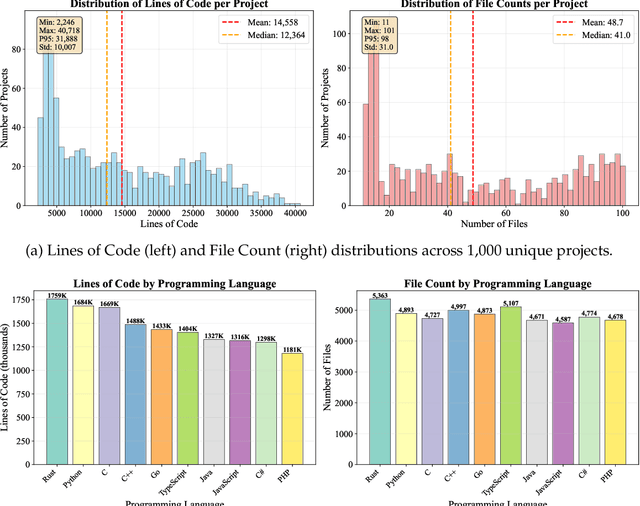
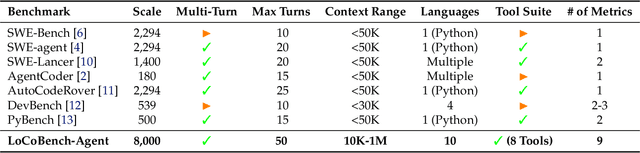
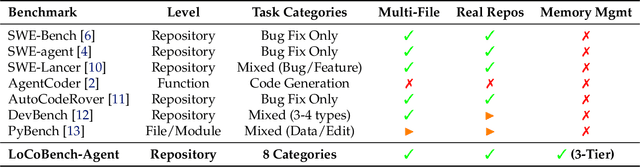
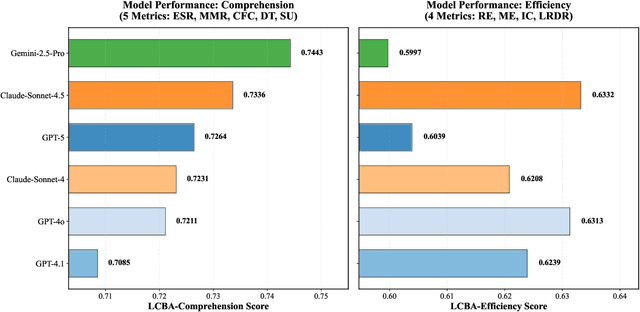
As large language models (LLMs) evolve into sophisticated autonomous agents capable of complex software development tasks, evaluating their real-world capabilities becomes critical. While existing benchmarks like LoCoBench~\cite{qiu2025locobench} assess long-context code understanding, they focus on single-turn evaluation and cannot capture the multi-turn interactive nature, tool usage patterns, and adaptive reasoning required by real-world coding agents. We introduce \textbf{LoCoBench-Agent}, a comprehensive evaluation framework specifically designed to assess LLM agents in realistic, long-context software engineering workflows. Our framework extends LoCoBench's 8,000 scenarios into interactive agent environments, enabling systematic evaluation of multi-turn conversations, tool usage efficiency, error recovery, and architectural consistency across extended development sessions. We also introduce an evaluation methodology with 9 metrics across comprehension and efficiency dimensions. Our framework provides agents with 8 specialized tools (file operations, search, code analysis) and evaluates them across context lengths ranging from 10K to 1M tokens, enabling precise assessment of long-context performance. Through systematic evaluation of state-of-the-art models, we reveal several key findings: (1) agents exhibit remarkable long-context robustness; (2) comprehension-efficiency trade-off exists with negative correlation, where thorough exploration increases comprehension but reduces efficiency; and (3) conversation efficiency varies dramatically across models, with strategic tool usage patterns differentiating high-performing agents. As the first long-context LLM agent benchmark for software engineering, LoCoBench-Agent establishes a rigorous foundation for measuring agent capabilities, identifying performance gaps, and advancing autonomous software development at scale.
GeoGNN: Quantifying and Mitigating Semantic Drift in Text-Attributed Graphs
Nov 12, 2025Graph neural networks (GNNs) on text--attributed graphs (TAGs) typically encode node texts using pretrained language models (PLMs) and propagate these embeddings through linear neighborhood aggregation. However, the representation spaces of modern PLMs are highly non--linear and geometrically structured, where textual embeddings reside on curved semantic manifolds rather than flat Euclidean spaces. Linear aggregation on such manifolds inevitably distorts geometry and causes semantic drift--a phenomenon where aggregated representations deviate from the intrinsic manifold, losing semantic fidelity and expressive power. To quantitatively investigate this problem, this work introduces a local PCA--based metric that measures the degree of semantic drift and provides the first quantitative framework to analyze how different aggregation mechanisms affect manifold structure. Building upon these insights, we propose Geodesic Aggregation, a manifold--aware mechanism that aggregates neighbor information along geodesics via log--exp mappings on the unit sphere, ensuring that representations remain faithful to the semantic manifold during message passing. We further develop GeoGNN, a practical instantiation that integrates spherical attention with manifold interpolation. Extensive experiments across four benchmark datasets and multiple text encoders show that GeoGNN substantially mitigates semantic drift and consistently outperforms strong baselines, establishing the importance of manifold--aware aggregation in text--attributed graph learning.